
Energy & Chemicals · Explainable AI · 2025
AI deal co-pilot for an energy major
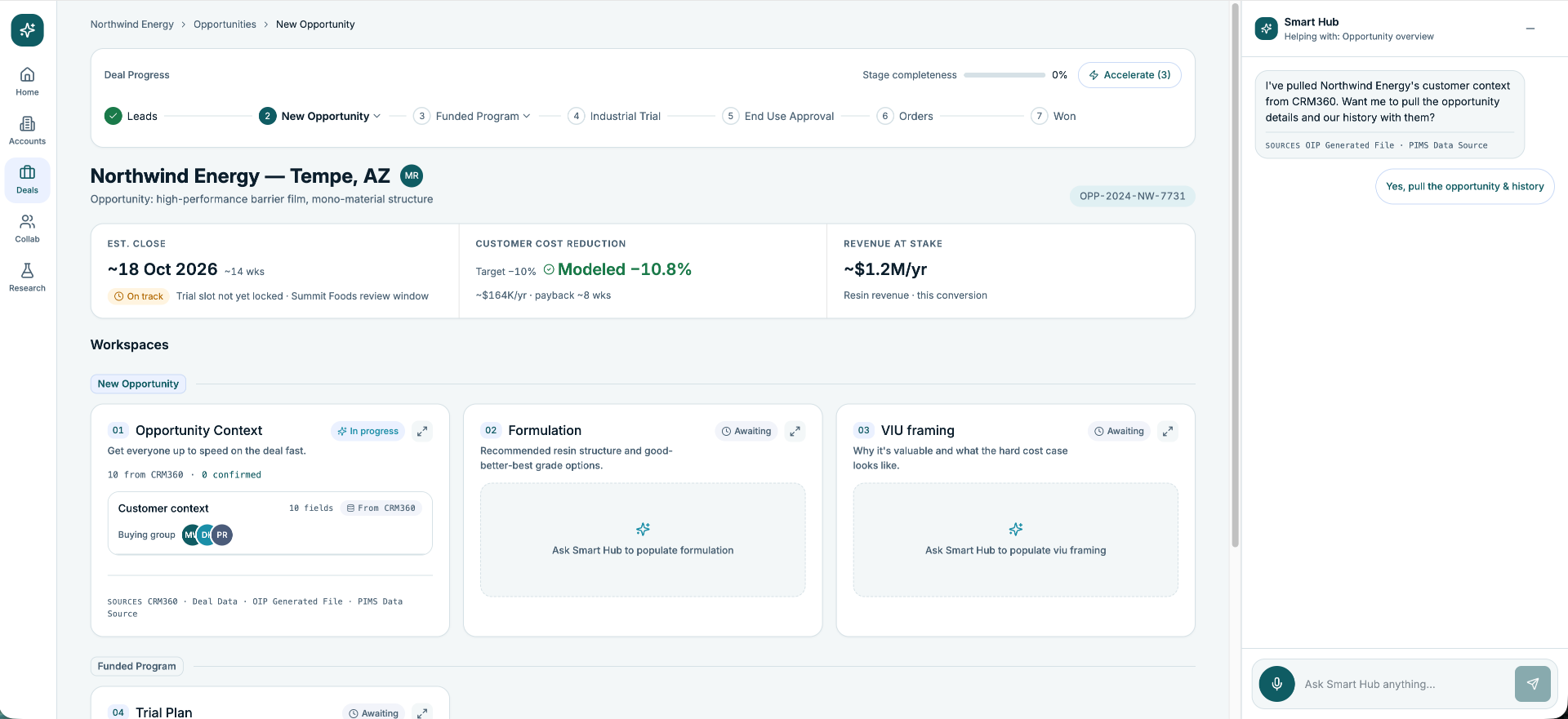
A global energy major sells highly technical materials into complex B2B accounts, where winning a deal depends on scarce veteran expertise. I designed an AI co-pilot that assembles the whole deal — customer context, the recommended technical solution, its value case, and a credible path to a trial — as a guided, source-grounded workspace, so the seller builds a defensible deal in the flow of the conversation rather than after weeks of specialist chasing.
- Client
- Global energy major (NDA)
- Role
- Senior Delivery AI UX Designer
- Year
- 2025
- Outcome
- ~45%
faster deal prep (projected)
Live prototype
Sanitised, interactive version of the deal workspace. Password-protected — contact me to request full access.
01 · The problem
Framed in business terms
Selling technical materials into large industrial accounts is a specialist sport. The right recommendation depends on decades of accumulated judgment about how a given material behaves in a given application on a given customer's line — knowledge that lived in a shrinking pool of veteran experts and in tens of thousands of scattered documents, not in any system a front-line seller could query. Deal cycles were slow and gated on the availability of a few experts; quality was inconsistent depending on who was in the room; and value was left on the table when a seller couldn't quickly frame a rigorous, numbers-backed case. As experienced staff retire, that expertise is eroding faster than it's being codified. Affected: front-line sellers (blocked without specialist support), technical advisors (a bottleneck for every deal), and sales leadership (inconsistent, unscalable deal quality).
02 · Why AI, why now
The constraint that made AI the right call
This was a genuine fit for AI, not a veneer. The decisions involved are exactly the kind AI is suited to: complex, interdependent, scenario-driven, and high-dimensional — thousands of products across thousands of applications, where the 'right' answer is a reasoned trade-off, not a lookup. Two constraints made it the right call now. First, the data foundation had just landed — the client had recently stood up an enterprise data platform, so for the first time there was clean, structured commercial data to ground an assistant's outputs; without it, an AI layer would have been guessing. Second, the expertise was eroding — with veteran sellers retiring, codifying their judgment into an assistant shifted from 'nice to have' to time-sensitive. AI was the only realistic way to democratize expert-grade judgment across a large seller base at speed.
03 · Workflow
Tool orchestration & sequence
- 01
Research synthesis
- Claude
- Strategy decks
- Responsible-AI standard
- Session transcripts
Ingested strategy decks, the client's responsible-AI standard, working-session transcripts, and a prior prototype handoff. Distilled the sales motion, value pools, and constraints — and drew the hard line between what the assistant could genuinely retrieve and what only a human could supply.
- 02
Information architecture
- Guided workspaces
- Client sales stages
- Close plan across stages
Modeled the deal as a set of guided workspaces mapped to the client's actual sales stages — opportunity context → recommended formulation → value-in-use / TCO → trial plan — with a close plan running across stages.
- 03
Rapid prototyping
- Figma Make
- Closed component system
- Fixed design tokens
- Scoped prompts
Scoped, incremental build prompts against a closed component system and fixed design tokens. Explicit "do not touch" scoping on every pass kept the generated UI consistent and stopped it regressing neighboring screens — the single biggest lever for quality in AI-assisted prototyping.
- 04
Validation loops
- Pinned client comments
- Whiteboard sessions
- Demo dry-runs
Turned pinned client comments, whiteboard sessions, and demo dry-runs into targeted prompt revisions, then re-validated after each pass. The prototype went through multiple rounds before the client demo.
04 · Key decisions
Where the human overruled the obvious path
Honesty about capability: agent-pull vs. human-input
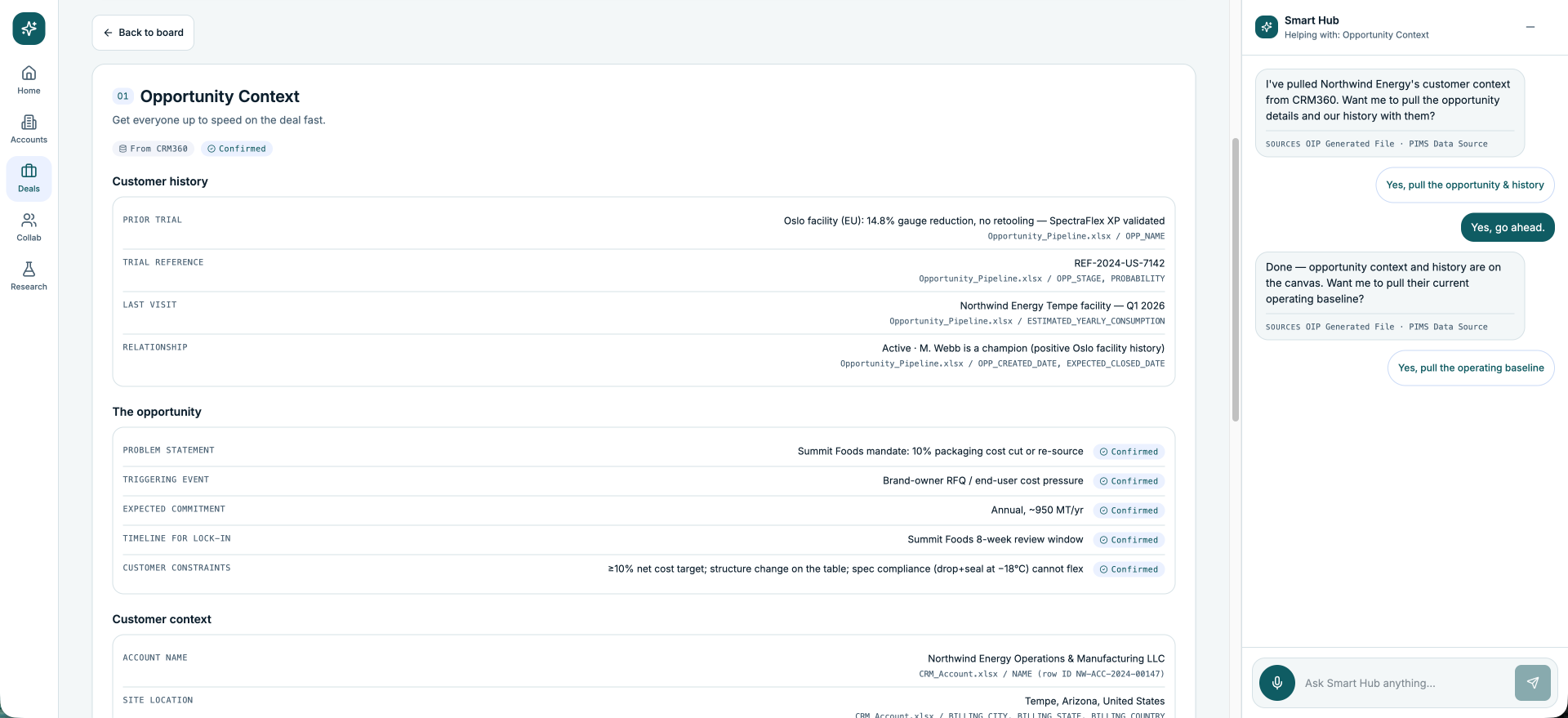
My first pass framed the 'advance' actions as the seller adding information. It demoed smoothly, but it implied the assistant could fetch things it actually couldn't, and it blurred the line between what the system knew and what a human had to supply. I reversed it: the assistant pulls what it can from data sources, always with a visible citation, and only the genuinely human-supplied inputs are framed as seller input. Making the tool honest about its own limits — at the cost of a slicker demo moment — aligned the product with the client's responsible-AI standard.
Legibility over cleverness: 'Ask' as the safe default
The assistant could have auto-detected whether a given chat turn should just answer or actually change the workspaces. Clever, but unpredictable in a live demo and unnerving for a user afraid of changing something by accident. I chose an explicit two-mode toggle (Ask to converse, Build to apply changes) with Ask as the default, plus a clear 'here's what changed and where' confirmation whenever the assistant did edit. User control and predictability beat a hidden classifier.
Narrative clarity over spectacle: staged reveal
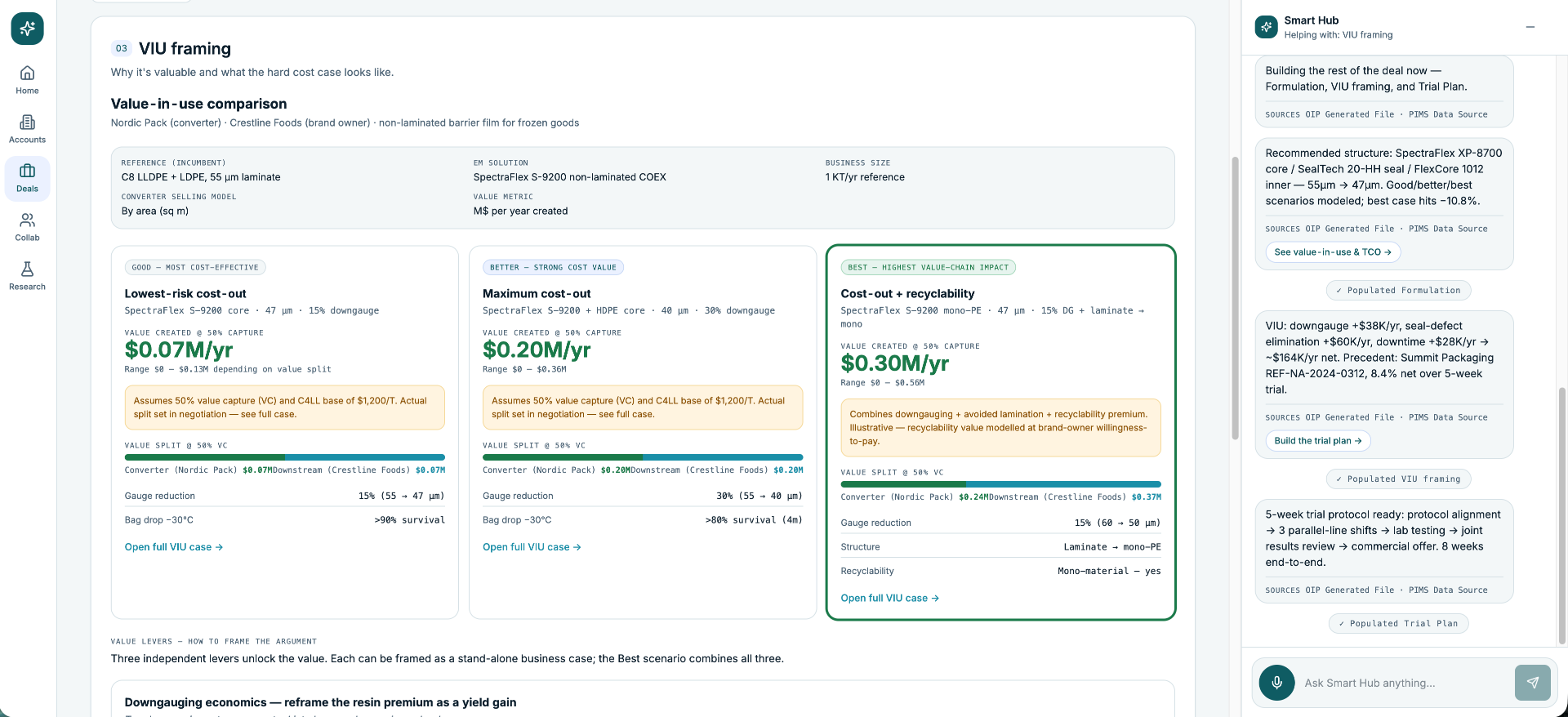
The prototype could populate every workspace at once — visually impressive, but illegible on first viewing and it buried the story under a wall of simultaneous output. I gated the experience into a click-to-advance conversation that builds one beat at a time: context first, then the opportunity, then what still needs confirming, then the rest of the deal. Traded the 'wow' of instant fill for a story a first-time viewer could actually follow.
05 · Outcome
Measured in the business, not the mockup
- Delivered a working prototype covering the full lead-to-close deal lifecycle as guided, source-grounded workspaces.
- Explainability built in to meet the client's responsible-AI standard: per-field source citations (down to file and field), a tri-state provenance model (system-known / human-confirmed / still-to-confirm), and human-in-the-loop modes.
- Iterated through multiple client validation rounds and presented to the client team.
- Projected impact (illustrative — modeled from the design, not measured): ~45% faster deal prep; ~50% fewer expert touchpoints per deal; ~2–3 weeks pulled out of time-to-trial; new-seller ramp in weeks, not quarters. Directional projections to size the opportunity; to be validated against a live pilot.
06 · Learnings
What I'd do differently
Lock the information architecture earlier. The workspace taxonomy churned mid-project — a restructure from one model to another, plus relocating the close plan — and each change rippled into prompt rework. I'd invest more upfront in aligning the client on the deal-lifecycle model before building screens, and I'd settle the 'who supplies what' contract (assistant-retrieved vs. human-entered) before designing the conversational flow, since ambiguity there caused a visible reversal I could have avoided.
Client details withheld under NDA. Numbers, workflow, and screenshots shown in anonymized, representative form.